Where the Capitoline Wolf is
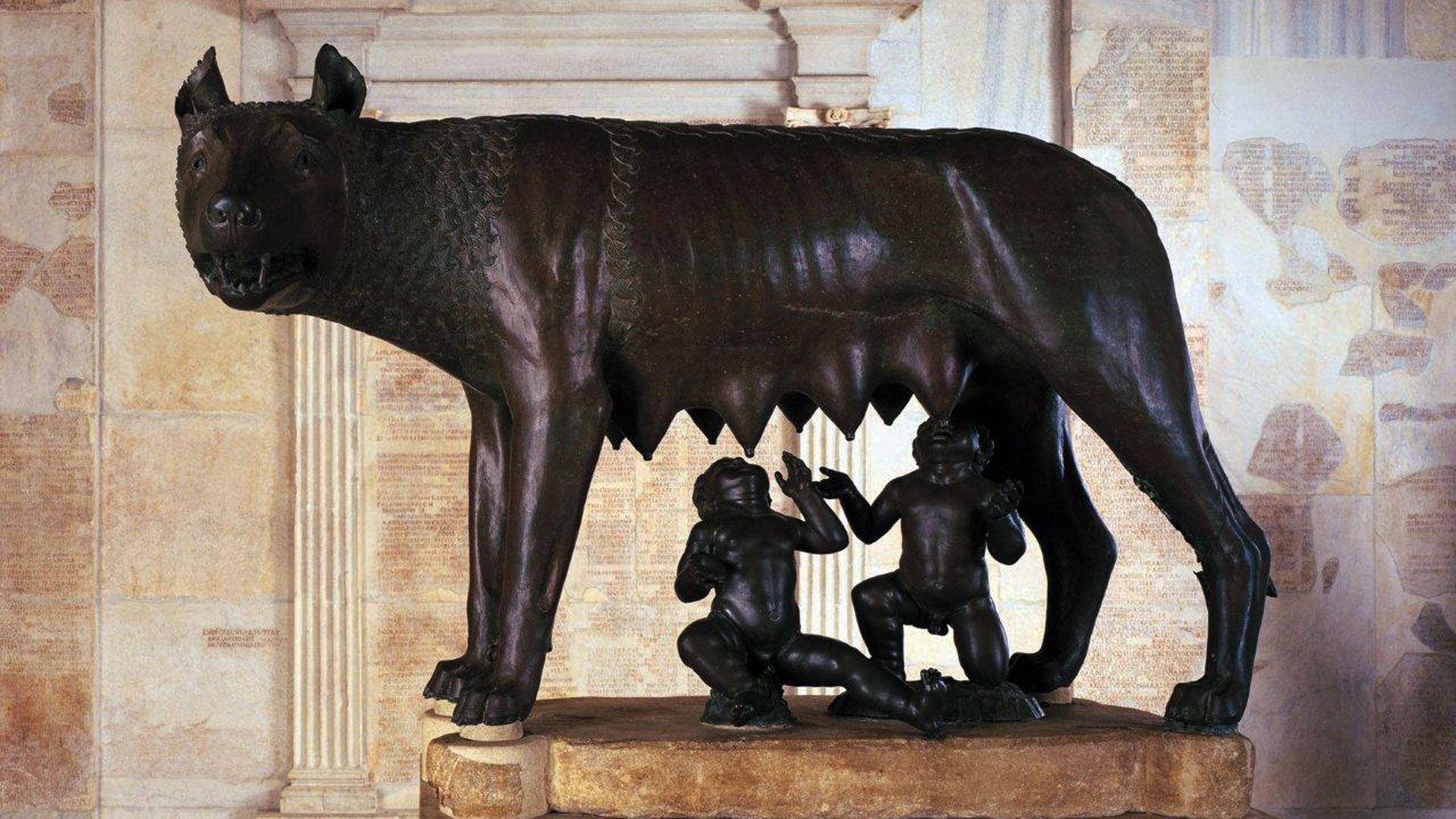
The Wolf is displayed in the Hall of the She-Wolf (Sala della Lupa), on the piano nobile of the Palazzo dei Conservatori — you'll find it along the main route of the Capitoline Museums, shortly after the Marcus Aurelius Exedra. No dedicated ticket needed: it's included in every entry ticket, from €15.
| Fact | Details |
|---|---|
| Where | Hall of the She-Wolf, Palazzo dei Conservatori, Capitoline Museums |
| Material | Lost-wax cast bronze; the twins were added in the Renaissance |
| Size | Roughly 75 cm high, 114 cm long |
| At the Capitoline since | 1471, Sixtus IV's gift to the people of Rome |
The story: from the Lateran to the Capitoline
Throughout the Middle Ages the Wolf stood at the Lateran, where — according to the chronicler Benedetto Canonico — justice was administered and sentences carried out beside the bronze. In 1471 Pope Sixtus IV gave it to the people of Rome along with the other great Lateran bronzes: that donation is the founding act of the Capitoline Museums, the oldest public museum in the world.
The twins are a Renaissance addition, traditionally attributed to Antonio del Pollaiolo: the Etruscan (or medieval — see below) she-wolf originally suckled no one, and it was papal Rome that turned her into the complete image of the myth of Romulus and Remus.
The dating mystery
For five centuries the Wolf was "the Etruscan bronze of the 5th century BC", attributed to the circle of the sculptor Vulca. In 2006, radiocarbon analysis of the casting clay, carried out during restoration, suggested a medieval date, somewhere between the 8th and 14th centuries: single-piece lost-wax casting was unknown to the Etruscans, who cast in separate parts. The academic debate isn't settled — the museum presents both hypotheses — but it doesn't change the essential point: this is the most identity-defining object Rome possesses.
How to see it well: practical tips
- Timing: the Hall of the She-Wolf is one of the most photographed rooms in the museum; at 9:30am or after 5pm you'll find it nearly empty, at midday there's a selfie queue.
- Look at the left flank: the hind legs show the damage from a lightning strike that, according to the sources, hit the bronze in 65 BC — one of the arguments made by supporters of the ancient dating.
- The comparison to make: on the same visit you can see the other Lateran bronzes from the 1471 donation — the Spinario and the Capitoline Brutus are just a few rooms away.
- Copies around Rome: the column in Piazza del Campidoglio and the Palazzo Senatorio display replicas; the original is only in here.
See the Wolf without the queue
Ticket with reserved entry: pick your time and go straight to the turnstiles.
What to see on the same visit
From the Hall of the She-Wolf you're steps away from the Exedra with the original equestrian Marcus Aurelius and from the fragments of the colossus of Constantine in the courtyard. Below the piazza, the Tabularium opens onto the Roman Forum; beyond it, the Palazzo Nuovo with the Dying Gaul and the Capitoline Venus. Check the opening hours and the current exhibitions at Villa Caffarelli to plan the full half day.
Frequently asked questions
Where is the original Capitoline Wolf?
In the Hall of the She-Wolf in the Palazzo dei Conservatori, at the Capitoline Museums in Rome. The wolves you see in Piazza del Campidoglio and elsewhere in the city are copies.
Do I need a separate ticket to see the Wolf?
No: the Wolf is included in the standard Capitoline Museums ticket (from €15, or €20.50 combined during exhibition periods).
Is the Capitoline Wolf Etruscan or medieval?
It's disputed: tradition dates it to the 5th century BC as an Etruscan work, but 2006 analyses of the casting technique and radiocarbon suggest a medieval date. The museum presents both hypotheses.
Are the twins under the wolf original?
No, Romulus and Remus were added in the Renaissance, traditionally attributed to Antonio del Pollaiolo. The ancient bronze showed the she-wolf alone.
Why is the she-wolf the symbol of Rome?
Because of the foundation myth: the she-wolf suckled the twins Romulus and Remus after they were rescued from the Tiber; Romulus went on to found the city in 753 BC. The City of Rome still uses the Capitoline Wolf as its emblem today.