First things first: the exhibition is over
The exhibition “Domitian the Emperor. Hate and Love” ran at Villa Caffarelli from 13 July 2022 to 29 January 2023 and can no longer be visited. If you landed here looking for tickets: they no longer exist, and any resellers still showing them simply haven't updated their pages.
The good news: much of what made that show interesting — the Flavian portraits, the context of imperial power, the Capitoline itself, which Domitian rebuilt — is on view year-round with a standard Capitoline Museums ticket. And in 2026 Villa Caffarelli hosts two major new exhibitions.
| Fact | Details |
|---|---|
| Title | Domitian the Emperor. Hate and Love (Domiziano imperatore. Odio e amore) |
| Venue | Capitoline Museums, Villa Caffarelli |
| Dates | 13 July 2022 – 29 January 2023 (ended) |
| Works | Around 100, from Italian and international museums, across 15 rooms |
What the exhibition told
Domitian (AD 81–96), the last emperor of the Flavian dynasty, is the most studied case of damnatio memoriae: after his assassination, the Senate erased his name and images. The exhibition overturned the caricature of the tyrant handed down by Tacitus and Suetonius, documenting the capable administrator: the completion of the Colosseum, the rebuilding of the temple of Jupiter Capitolinus after the fire of AD 80, and the stadium whose outline is today's Piazza Navona.
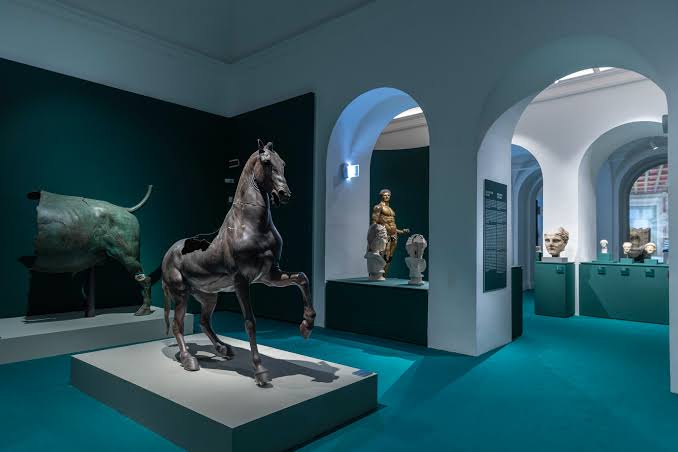
The route through 15 rooms lined up reworked portraits (heads of Domitian recarved as Nerva after the damnatio), bronzes, coins and reliefs — a hundred or so loans unlikely ever to be reunited. The display against deep-green backdrops, visible in the photo below, remains one of Villa Caffarelli's most successful.
Where to see Domitian at the Capitoline today
- Hall of the Emperors (Palazzo Nuovo): the chronological gallery of 67 imperial busts includes the Flavian portraits — Vespasian, Titus and the portraiture of Domitian's era, recognisable by its deeply drilled curls. The room guide is on the Palazzo Nuovo page.
- The temple of Jupiter Capitolinus: the tuff foundations visible on the route towards Villa Caffarelli belong to the temple that Domitian himself lavishly rebuilt after the fire of AD 80.
- Outside the museum: Piazza Navona preserves the exact footprint of Domitian's stadium; the stadium's underground remains can be visited separately, entering from Piazza di Tor Sanguigna.
Domitian's Capitoline can be visited today
Flavian portraits, the temple of Jupiter and the Capitoline bronzes: all in the museum ticket.
The exhibitions running in 2026
If you were after a major show at the Capitoline, Villa Caffarelli hasn't stood empty:
- “Vasari and Rome” — until 19 July 2026, included in the museum's combined ticket (€20.50);
- “Diego Rivera and the Making of Modern Art in Mexico” — 9 June – 13 December 2026, the first Italian monographic show on the Mexican muralist.
Dates, rates and how the combined ticket works are on the Villa Caffarelli page; the museum's opening hours are here.
Frequently asked questions
Is the Domitian exhibition at the Capitoline Museums still open?
No: “Domitian the Emperor. Hate and Love” closed on 29 January 2023 at Villa Caffarelli. In 2026 the same venue hosts “Vasari and Rome” (until 19 July) and “Diego Rivera” (9 June – 13 December).
Where can I see portraits of Domitian today?
At the Capitoline Museums in the Hall of the Emperors in the Palazzo Nuovo, with the Flavian portraiture, and in other Roman museums such as Palazzo Massimo. The museum's standard ticket is all you need.
What does Domitian have to do with the Capitoline?
After the fire of AD 80, Domitian rebuilt the temple of Jupiter Capitolinus, the most important temple of ancient Rome: its foundations are visible on the museum route towards Villa Caffarelli.
Who was Domitian, in brief?
Emperor from AD 81 to 96, the last of the Flavian dynasty. An efficient administrator but an autocrat, he was assassinated in a conspiracy and condemned to damnatio memoriae by the Senate: his name and portraits were erased or reworked.
Can you visit the Stadium of Domitian?
Yes: the underground remains of the Stadium of Domitian beneath Piazza Navona are a separate visitable site, entered from Piazza di Tor Sanguigna. The piazza itself preserves the stadium's shape.