What is the Palazzo Nuovo
Facing the Palazzo Senatorio from the top of the cordonata ramp, the Palazzo Nuovo is the building on your left. "New" is relative: it was completed in 1663 to a Michelangelo-inspired design, a mirror twin of the Palazzo dei Conservatori opposite. Since 1734 — the year Pope Clement XII opened the Capitoline Museums to the public — it has been the home of the museum's ancient sculpture.
It has no separate entrance: you enter through the Palazzo dei Conservatori, cross the Galleria Lapidaria beneath the piazza, climb to the Tabularium for the view over the Forum, and come up inside the Palazzo Nuovo. It's included in every Capitoline Museums ticket, with no supplements.
| Fact | Details |
|---|---|
| Where | Piazza del Campidoglio, left (north) side |
| Ticket | Included in Capitoline Museums entry (from €15) |
| Suggested time | 45–60 minutes |
| Don't miss | Dying Gaul, Capitoline Venus, Marforio, Hall of the Emperors, Mosaic of the Doves |
The masterpieces, floor by floor
Courtyard: the Marforio
Just inside, the courtyard fountain is dominated by the Marforio, a colossal river god of the 1st–2nd century. Romans know him as one of the city's "talking statues": for centuries anonymous satires against the powerful were pinned beside him, in dialogue with Pasquino.
Piano nobile: the Dying Gaul
In the Hall of the Gladiator awaits the most celebrated piece: the Dying Gaul, a Roman marble copy of a Hellenistic bronze from Pergamon. The wounded Celtic warrior, caught in the instant before death, is among the most copied and studied sculptures of all time — Byron devoted lines of Childe Harold to him. Walk all the way around: the composition works from every angle, a rare thing in ancient sculpture.
The Cabinet of Venus
The Capitoline Venus has a small octagonal room all to herself. Carved in Parian marble, she is a variant of Praxiteles' Venus of Cnidus, found almost intact in the seventeenth century. The placement is deliberate: you come upon her from behind, as if surprising her at her bath.
Hall of the Emperors and Hall of the Philosophers
Sixty-seven imperial busts in chronological order: from Augustus to the Severans, the physiognomy of Roman power in a single room. Next door, the Hall of the Philosophers holds the portraits of Homer, Socrates and Cicero. These are the two favourite rooms of anyone who loves history more than art: here the faces from the books are half a metre from yours.
The Great Hall and the Mosaic of the Doves
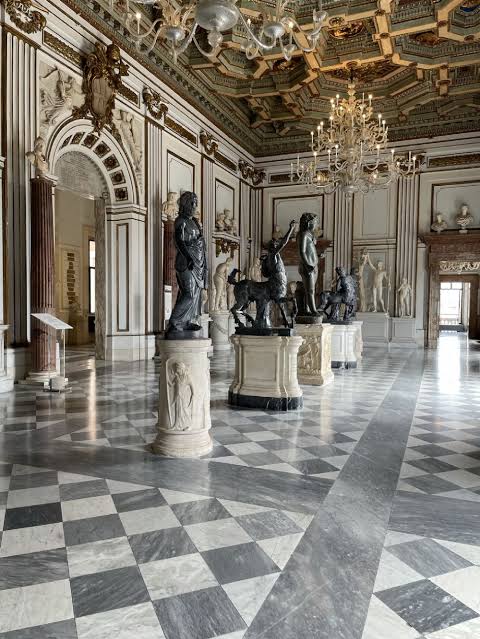
In the central Great Hall, beneath a wooden ceiling and between columns, the two grey-marble Centaurs from Hadrian's Villa stand out. In the Hall of the Doves, the mosaic of the same name — four doves perched on a bronze bowl — also comes from Hadrian's Villa and is so fine it looks painted: 3-millimetre tesserae.
Practical tips for your visit
- Route order: the natural flow (Conservatori → underground → Palazzo Nuovo) saves the Gaul as the grand finale. Short on time? Go against the current: head straight to the Palazzo Nuovo at opening and enjoy it empty.
- Light: the piano nobile rooms get natural light from high windows; around midday the marbles photograph best.
- With children: the Hall of the Emperors works as a game ("find the emperor with the strangest beard"); the whole palace can be done in 30 minutes.
- Accessibility: internal lift and step-free underground link from the Palazzo dei Conservatori.
One ticket, two palaces
Palazzo Nuovo, Conservatori, Tabularium and Pinacoteca: all on the same entry.
What to see alongside it
The Palazzo Nuovo is only half the story: across the piazza, the Palazzo dei Conservatori holds the Capitoline Wolf and the Marcus Aurelius, while the Villa Caffarelli wing hosts the temporary exhibitions. Check the opening hours and plan at least half a day on the hill.
Frequently asked questions
Does the Palazzo Nuovo have a separate ticket?
No: it's part of the single Capitoline Museums route. With your entry ticket you visit the Palazzo dei Conservatori, the Galleria Lapidaria, the Tabularium and the Palazzo Nuovo.
Where is the Dying Gaul?
In the Hall of the Gladiator, on the piano nobile of the Palazzo Nuovo at the Capitoline Museums. It's a Roman marble copy of a Hellenistic bronze original from Pergamon.
How much time do I need for the Palazzo Nuovo?
45 minutes to an hour to see it at a comfortable pace; half an hour if you go straight for the masterpieces (Gaul, Venus, Hall of the Emperors, Marforio).
Why is it called Palazzo Nuovo?
Because it was the last of the three palaces on the piazza to be built: completed in 1663 to a design inspired by Michelangelo's drawings, to close the square symmetrically.
Can you enter the Palazzo Nuovo directly from the piazza?
No, the visitor entrance to the Capitoline Museums is at the Palazzo dei Conservatori; you reach the Palazzo Nuovo from inside, through the underground gallery.